
You do not double bookings by asking agents to work twice as hard. You do it by stopping the administrative workload from doubling every time show volume grows, then reinvesting the recovered capacity in outbound, negotiation, artist strategy and promoter relationships.
That requires four changes:
- Capture booking information without making an agent re-enter it.
- Keep every update connected to the right artist, show and next action.
- Make exceptions, not every booking, the unit of human work.
- Give the recovered time a commercial purpose.
Doubling is an ambitious target, not a guaranteed Rellay result. But it is the right target to test before accepting that twice the shows must mean twice the back office.
Every new show currently carries an administrative tax.
A confirmed booking creates much more than one line in a calendar.
It creates offers, holds, changes, contracts, reminders, advancing, travel information, invoices, settlements, artist questions and internal handovers. Every one of those steps can create another search, another copy, another status check and another follow-up.
The result is a growth curve most agency owners know too well:
More shows → more coordination → more admin → another hire → the same bottleneck at a higher volume.
Hiring relieves the pressure. It does not automatically fix the curve.
The alternative is not to remove people. It is to stop using people as the connection between email, booking software, calendars, documents and finance.
One real agency shows how quickly the hidden workload grows.
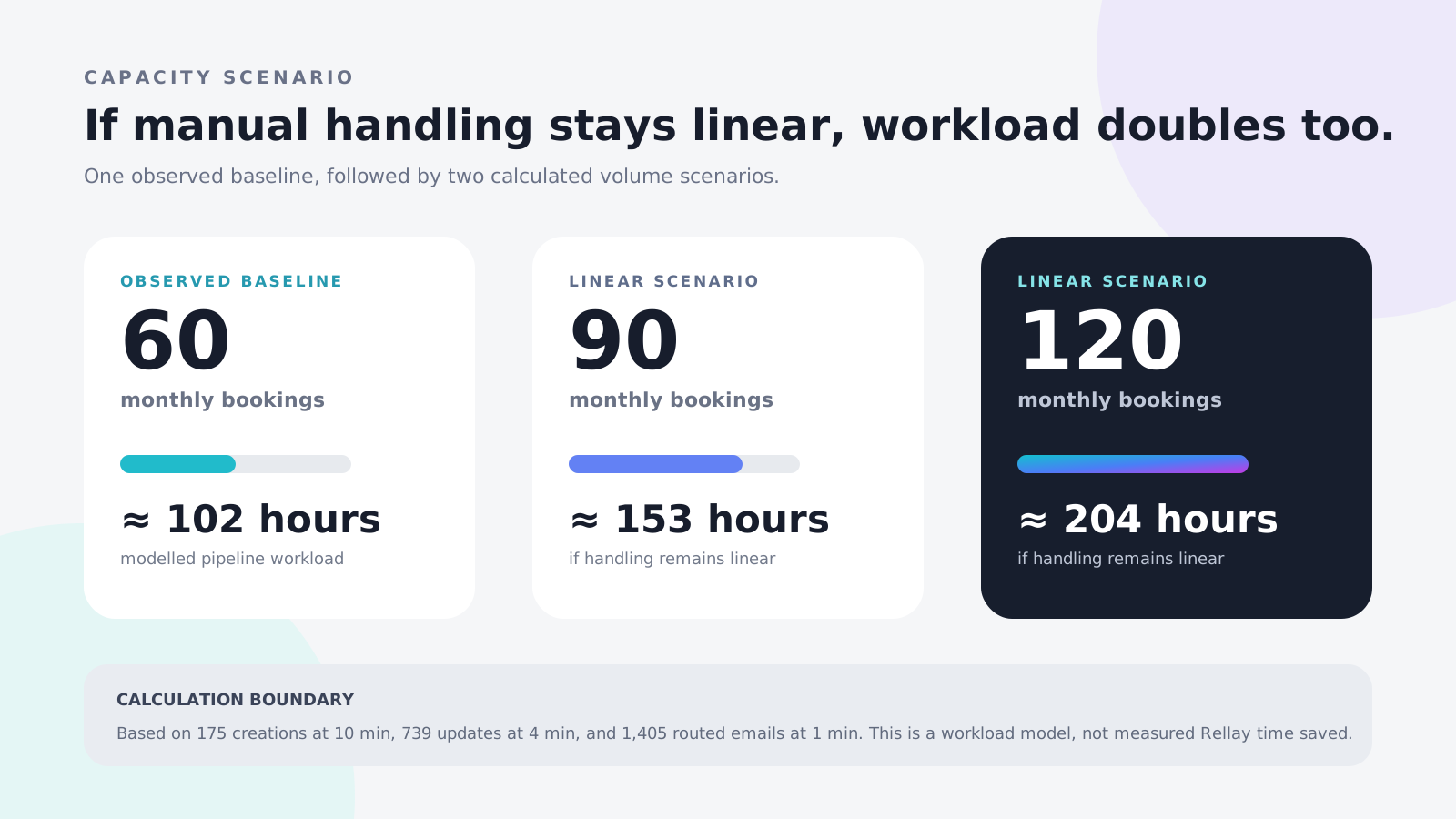
In one anonymised Rellay production case, approximately 60 confirmed bookings per month sat behind this operating volume:
| Monthly activity | Observed volume |
|---|---|
| Emails processed | 4,188 |
| Deals created | 175 |
| Deal updates written | 739 |
| Emails routed by intent | 1,405 |
That is 914 creations or updates written into the booking operation every month.
Applying the documented manual-handling assumptions to the observed volumes produces approximately 102 hours of pipeline workload per month. This is a calculation, not a stopwatch study, and it does not mean Rellay eliminated every one of those hours.
It shows the scale of the work wrapped around the bookings.
If the same process stayed completely linear at twice the booking volume, the model would approach 204 monthly hours before counting contracts, advancing, travel, finance or artist coordination.
The owner sees another salary. The system sees hundreds of repeated actions that should not require the same human effort every month.
1. Stop making agents create a second version of every conversation.
An offer already contains the date, venue, capacity, fee, contact and often the next question.
In a manual workflow, the agent reads it and then reconstructs the same information inside the booking platform. When the promoter replies, the agent does it again. The software becomes useful only after a person has fed it.
Rellay reverses that direction of work.
Incoming information can be connected to the relevant artist and show, interpreted as booking data and turned into a proposed or completed operational update. The agent reviews what matters instead of creating the record from scratch.
At that point, manual re-entry stops being a fixed cost attached to every opportunity.
2. Remove the joins, not only the keystrokes.
Faster data entry is not enough.
A changed date must reach the calendar. A confirmed fee must reach the current deal. A new contract version must stay attached to the right booking. Advancing, travel, finance and artist information must work from the same underlying reality.
If the AI only summarises the email, the team still has to carry the update through the rest of the operation.
Rellay combines the specialised AI and the ERP in one product. The booking does not need to jump between an assistant and a separate operational backbone. The conversation, structured record, ownership, next action and history remain connected.
This is where capacity appears. Not from typing faster, but from preventing the same change from becoming five separate tasks.
3. Make exceptions the unit of human work.
Not every update deserves the same attention.
A phone-number correction is not a fee change. A standard follow-up is not an artist commitment. A proposed deal is not a signed contract. A clean update is not a conflict between two dates.
The traditional workflow sends everything through a person because the software cannot distinguish the risk.
An AI-native workflow can prepare routine work, surface the source and direct human attention towards uncertainty, exceptions and sensitive decisions.
That does not mean removing review. It means spending review where judgement creates value.
The capacity shift is simple:
- fewer people checking routine information;
- more people resolving difficult situations;
- fewer agents rebuilding context;
- more agents progressing opportunities.
4. Give every recovered hour a commercial job.
AI does not create demand for an artist by itself.
It creates capacity. What the agency does with that capacity determines whether more shows follow.
Recovered time can go into:
- reaching promoters before the calendar fills;
- developing new territories;
- building better pitches;
- following up consistently;
- negotiating with more context;
- spending more time on artist strategy;
- maintaining the relationships that produce the next opportunity.
This is the part most automation plans miss.
If agents save time and the agency fills it with more internal reporting, the commercial result will be limited. If the owner decides in advance that recovered capacity belongs to outbound and artist development, the operational improvement has a route to more bookings.
The same team does not mean no new people.
A growing agency should hire when it wants more human talent.
Hire another agent to build markets and relationships. Hire an artist-development lead to deepen the roster strategy. Hire finance or operations expertise when complexity requires it.
Do not hire people mainly to carry data between systems.
Before opening the next role, split its work into two columns:
| Human-value work | Repeated information work |
|---|---|
| Negotiating terms | Copying offer details |
| Advising artists | Updating routine statuses |
| Developing promoters and territories | Routing standard messages |
| Solving difficult routing | Preparing standard reminders |
| Handling sensitive communication | Reconstructing a booking from several sources |
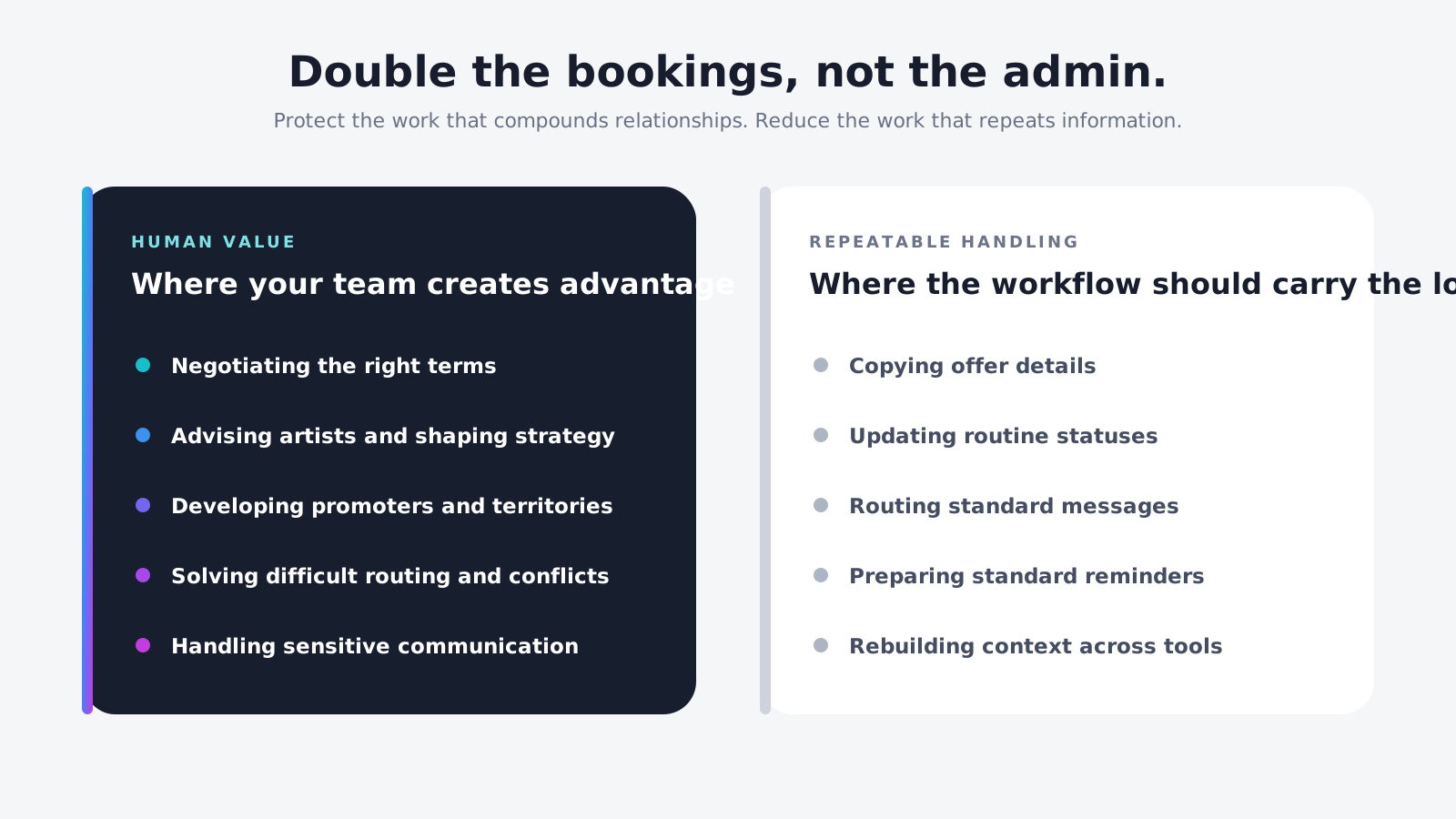
If most of the role sits on the right, fix the workflow first.
If it sits on the left, hire the person and give them a system that protects their time.
Build your capacity plan from evidence, not the headline.
Take one month of real agency activity and establish four numbers:
- bookings created and confirmed;
- operational messages and booking updates;
- time spent on re-entry, routing, checking and follow-up;
- corrections, exceptions and sensitive decisions requiring human judgement.
Then decide where the released capacity will go. Give outbound, artist development or promoter follow-up a measurable target.
Finally, model 1.5 times and twice the current volume. The question is not whether AI can make a booking agent look fast in a demo. It is whether review workload and operating quality remain under control when the inbox doubles.
Rellay cannot promise to double your bookings. No honest product can.
What Rellay can change is the relationship between show volume and administrative load.
That is how the same team gets a credible chance to handle twice the opportunity without working twice the hours.
Bring us one month of booking volume.
We will map what grows with every show, what still needs human judgement and where your agency can create capacity.
Talk to Rellay