
Booking agencies can already remove much of the manual work of copying dates, fees, venue details, and status changes from email into their booking system. The right model pairs AI extraction and updates with human review for sensitive decisions and exceptions.
A promoter sends an offer by email.
Your agent reads it, opens the booking platform, finds the artist, creates the show, copies the date, pastes the fee, adds the venue, sets the status, and writes a note.
Twenty minutes later, the promoter changes the date.
Your agent does it all again.
This is still treated as normal work in booking agencies. It should not be.
In 2026, asking an experienced booking agent to transfer structured information from one screen to another is not a process. It is a tax on every show your agency handles.
AI can already read the message, identify the booking, extract the useful information, and prepare or apply the update. Rellay is already doing this on real agency traffic.
The question is no longer whether manual data entry can disappear. The question is why your best people are still doing it.
One email rarely creates one update
The phrase "data entry" makes the problem sound smaller than it is.
An offer can create work in the booking platform, calendar, contract, artist communication, task list, advancing file, and finance system. A change to the date, fee, venue, billing, or contact can travel through the same chain again.
The agent becomes the integration layer.
They read the conversation, decide what matters, locate the right record, enter the new information, and remember which other places depend on it. If a colleague handled the previous exchange, they first have to reconstruct what happened.
The booking software may be perfectly capable of storing the final data. It still waits for a human to feed it.
That design made sense when software could only store what people entered. It makes much less sense when AI can understand the conversation where the information first appears.
The hidden workload is already measurable
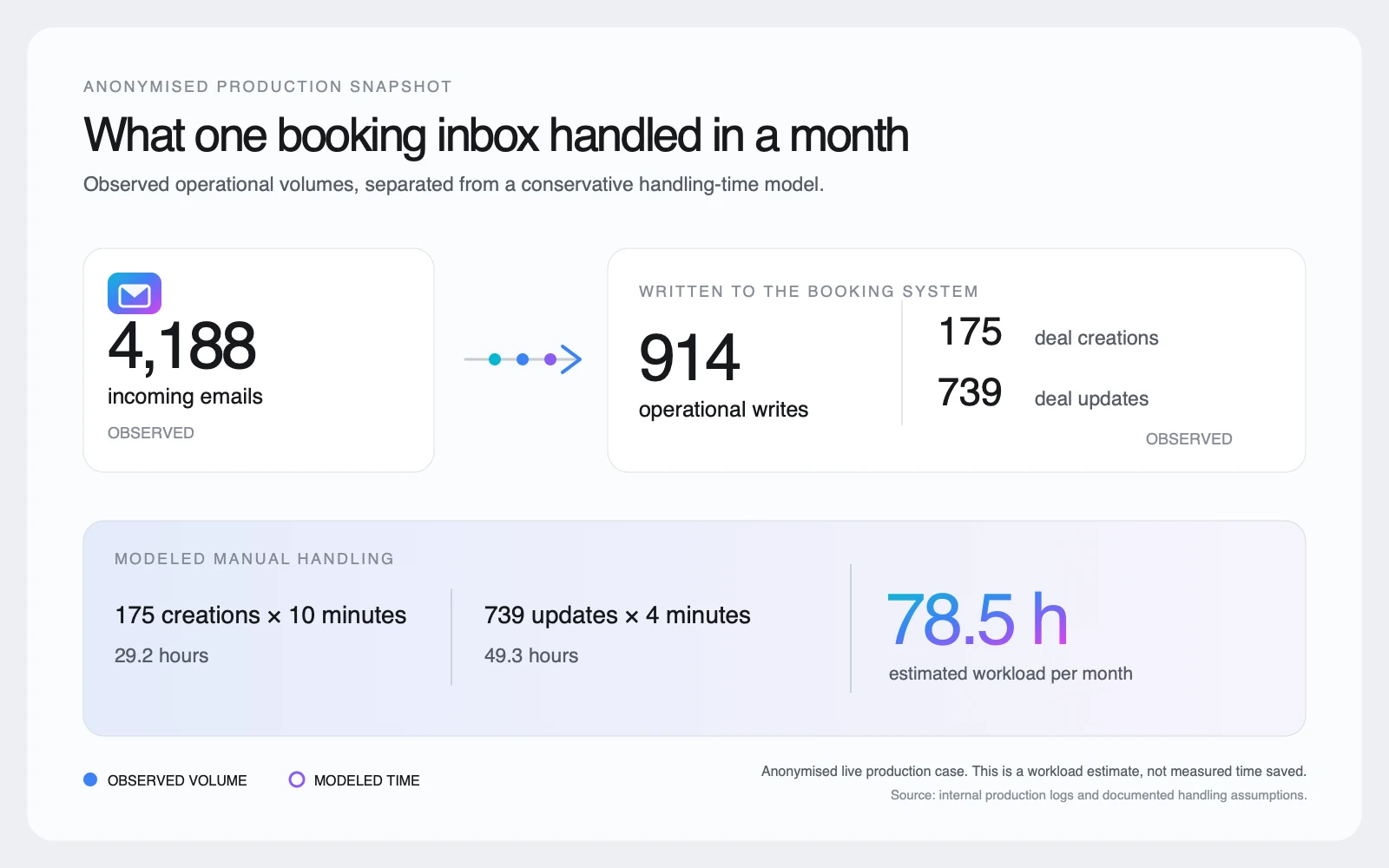
In one anonymised booking-agency case, Rellay processed the following monthly volume:
| Observed monthly activity | Volume |
|---|---|
| Emails scanned | 4,188 |
| Deals created | 175 |
| Deal updates | 739 |
| Total deal writes | 914 |
That is 914 moments in one month when information moved from the inbox into the booking operation.
The number is specific to one agency. It is not a market average, and it does not prove that every action was perfect. It does show why manual entry becomes a capacity problem long before it looks like one on an individual email.
Using documented assumptions of 10 minutes for a manual creation and four minutes for an update, those 914 writes represent about 78.5 hours of handling. Add the observed email-routing workload and the full pipeline model reaches approximately 102 hours per month.
Again, this is a transparent model based on real volumes and stated assumptions. It is not a stopwatch measurement or a guaranteed saving.
It is still a useful question for any owner: what would your agents do with even part of that time back?
AI should remove entry, not remove control
There is an obvious objection.
If the AI enters the wrong fee, assigns the email to the wrong artist, or misses a date change, the agency may spend more time correcting it than it would have spent entering the data manually.
That objection is right.
The answer is not to keep every person typing forever. It is to apply different levels of control to different information.
A new phone number is not the same as a new fee. A routine contact update is not the same as a confirmed show date. A missing hospitality detail is not the same as a radius conflict.
The operation should make those differences visible. Low-risk information can move with lighter review. Sensitive changes should be held for the right person. New deployments should start in parallel with the current process until the team has measured what needs correction.
AI does not need blind trust. It needs a clear path to earn trust.
Stop making agents document work after they have done it
Most systems ask the team to complete the conversation and then document the result.
The agent negotiates in email. Then they update the platform. They agree a new date. Then they update the calendar. They receive a contract. Then they update the status. They answer the artist. Then they add a note so the rest of the team knows what happened.
This creates a permanent delay between reality and the system of record.
Rellay starts from the incoming information. It connects the message to the relevant artist and show, then creates or updates the booking work from that context. The agent reviews the decisions that matter instead of rebuilding every field by hand.
That is a more useful definition of AI-native booking software. The AI is not an extra button waiting for a prompt. It is involved at the point where the work enters the agency.
What agents should do with the time
Removing data entry is only valuable if the agency is deliberate about what replaces it.
The answer should not be more internal reporting or another layer of software administration.
Use the time for work that changes the result:
- calling promoters before the opportunity goes cold;
- building routes instead of updating route spreadsheets;
- giving artists better advice;
- reviewing quiet territories and missed opportunities;
- negotiating the details that affect the relationship;
- finding the right show rather than processing the latest one.
One agency in our research estimated that 40% to 50% of its bookings came together through outbound work and promoter relationships. That percentage belongs to that agency, not the whole market. The principle travels further: admin capacity only becomes commercial value when the team reinvests it in selling and relationships.
Manual entry is particularly expensive because it consumes attention without improving the agent's judgement.
Your team already knows how to copy a date. That is not what you hired them for.
Run the ten-email test
Do not start with a transformation programme.
Take ten real booking emails from the last week. Include a clean offer, a changed date, an incomplete request, a fee negotiation, and one thread that refers to an existing show.
For each email, record:
- How long it takes a person to find the correct booking.
- Which fields they create or change.
- Which other tools they touch.
- Which decisions genuinely require judgement.
- What they have to double-check.
Then run the same ten emails through Rellay in parallel.
Do not judge the result by how impressive the summary looks. Judge it by how much correct booking work reached the right place, how much review remained, and whether the agent could move to the next opportunity sooner.
The result may show that the agency is ready to remove most routine entry. It may show that one field or workflow still needs work. Either answer is more useful than continuing to assume manual entry is unavoidable.
Data entry had a good run
Booking software once replaced paper planners and disconnected spreadsheets. That was a major improvement.
The next improvement is just as clear.
Information should not wait for an agent to carry it from the conversation into the operation. AI can already do much of that work. Humans should control the sensitive decisions, correct the exceptions, and spend the rest of their time on artists and promoters.
Manual booking data entry is not the future of the job.
It is simply a habit the industry has not removed yet.
Bring ten real booking emails.
Test how much manual entry your agency can remove while keeping the decisions that matter under human control.
Test the workflow with Rellay